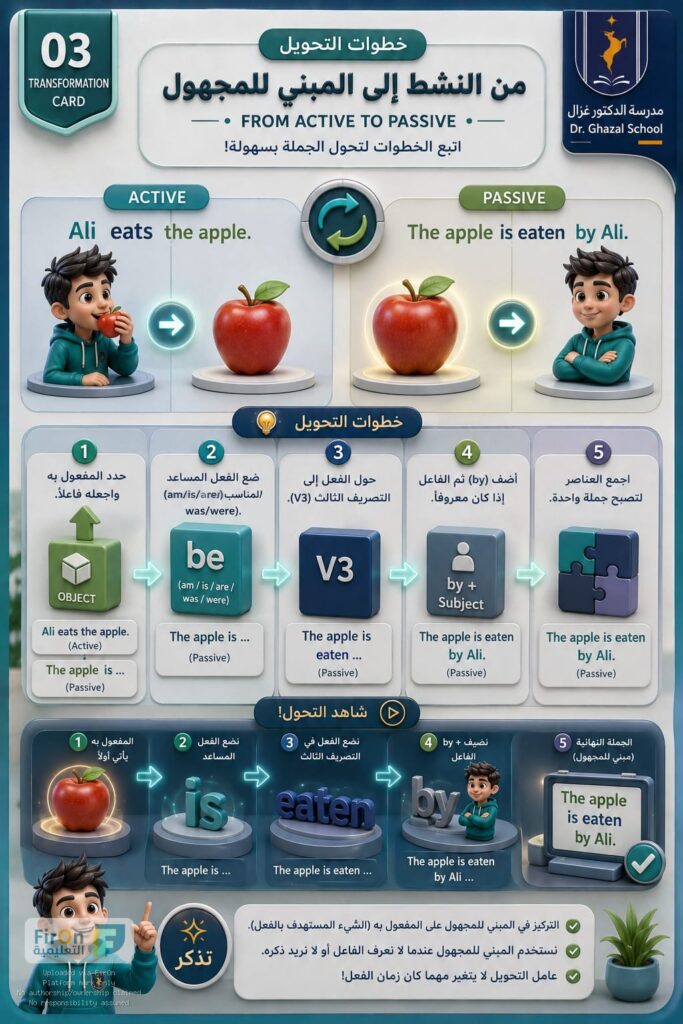
active and passive
تقييم البرومبت
وظيفة البرومبت
يساعد البرومبت المعلم على اعداد خطة درس كاملة وأنشطة صفية وتقويم ختامي
بيانات البرومبت
active and passive
متقدم
العربية
Gemini
مسودة
متغيرات ينصح بتعديلها قبل الاستخدام
active and passive voice for nineth grade
نص البرومبت
خطة درس كاملة للتعليم المتمايز
البرومبت
أنت خبير في تصميم الدروس الحديثة والتعليم المتمايز.

صمم لي في ملف pdf بخط واضح و مناسب للطباعة خطة درس كاملة للبيانات التالية:

المادة: [لغة انجليزية]
الصف الدراسي: [التاسع]
موضوع الدرس: [active and passive voice]
مدة الحصة: [40
عدد الطلاب: [27]

أريد أن تتضمن الخطة:

1- نواتج التعلم بصيغة واضحة وقابلة للقياس.

2- تقييمًا قبليًا سريعًا من 3 أسئلة:

سؤال دعم

سؤال بالمستوى المتوقع

سؤال تحدٍ للمتقدمين


3- تمهيدًا مشوقًا يربط الدرس بحياة الطلاب.

4- شرح الدرس باستخدام أكثر من مدخل:

مثال من الحياة الواقعية

شرح بصري أو تنظيمي

شرح لفظي مبسط


5- استراتيجيات تعلم نشط مناسبة لهذا الدرس مع شرح خطوات تنفيذ كل استراتيجية داخل الفصل.

6- خطة تعليم متمايز تتضمن:
أ- مستوى الدعم:

أنشطة مبسطة

أسئلة سهلة

وسائل مساعدة


ب- المستوى المتوقع:

أنشطة تحقق الهدف الأساسي للدرس

أسئلة فهم وتطبيق


ج- المستوى المتقدم:

أنشطة إثرائية

أسئلة تفكير عليا وتحليل وتقييم وإبداع


7- مهمة رئيسية واحدة يمكن تنفيذها بثلاث صور مختلفة مع الحفاظ على نفس الهدف التعليمي.

8- أسئلة صفية متدرجة:

تذكر

فهم

تطبيق

تحليل

تقييم

إبداع


9- أفكار مناسبة للفصول الكبيرة والمزدحمة.

10- تذكرة خروج متمايزة تتضمن:

سؤال دعم

سؤال بالمستوى المتوقع

سؤال للمتقدمين


11- جدول زمني للحصة دقيقة بدقيقة.

اجعل جميع الأنشطة عملية وقابلة للتنفيذ داخل فصل عادي يضم عدداً كبيراً من الطلا
مخرجات البرومبت
المخرج النصي من البرومبت
Full Differentiated Lesson Plan
Subject: English Language Grade Level: Grade 9
Lesson Topic: Active and Passive Voice (Present Simple) Duration: 40 Minutes
No. of Students: 27 Students Classroom Type: Regular / Medium-to-Large Class
By the end of this lesson, students will be able to reach the following measurable goals:
• Cognitive (Differentiate): Identify and distinguish between Active and Passive voice sentences in the Present Simple tense with at least 80% accuracy.
• Application (Convert): Convert sentences from Active to Passive voice accurately, identifying the subject and object correctly.
• Analytical (Infer): Infer the structural reason for using the Passive voice (when the action/object is more important than the agent, or the agent is unknown) within context.
Conducted in the first 3 minutes using the “Colored Card Signaling” or quick mini-whiteboard response strategy to gauge student readiness:
A) Contextual / Real-Life Approach:
The Restaurant Scenario: In a restaurant, customers care deeply about the food itself, not necessarily the specific chef cooking it behind closed doors.
• Active:
• Passive:
(Focus on the chef) (Focus on the delicious food)
B) Visual & Structural Approach:
Draw Cross-Arrows on the board to clearly map structural changes:
Use contrasting colors on the whiteboard: Blue for the Object, Red for the helping verb is/are , and Green for the Past Participle (V3).
C) Verbal / Linguistic Rule:
A simple rhythmic chant for students to repeat: “Start with the Object, add ‘is’ or ‘are’, put the Verb in Phase 3, and you’re the star!” Explaining that the passive voice flips the focus onto the receiver of the action, adding a helping vitamin ( is/are ) and dressing the verb in its 3rd form uniform.
Strategy Name Step-by-Step Classroom Implementation (Class of 27)
Think – Pair – Share 1. The teacher writes a sentence on the board: “The students write essays.”
2. Think (1 min): Every student works silently to convert it individually.
3. Pair (1 min): Students turn to their immediate desk partner to compare and refine answers without disruption.
4. Share (1 min): The teacher calls on 3 pairs randomly to share their findings with the class.
Developed Numbered Heads 1. Students are arranged into 5 stable seating groups (5-6 students per row/cluster).
2. Each student in a group is assigned a number from 1 to 6.
3. The teacher gives a target conversion problem. The group discusses to ensure everyone (especially struggling peers) understands the answer.
4. The teacher calls out: “Number 3s, raise your hands and answer!” This ensures total individual accountability in a crowded room.
Option (A) – Support Level Option (B) – Expected Level Option (C) – Advanced Level
Fill-in and Reorder: Students receive pre-made passive sentences missing only helping verbs or past participles:
The whiteboard (is / are) cleaned.
The rubbish (is collected / collects). Direct Sentence Conversion: Students receive a checklist of active active sentences and
convert them completely:
1. Ali opens the windows.
2. Sami sweeps the floor.
Convert both to full passive. Free Writing & Evaluation: Students write a 4-sentence official status report to the
principal describing the state of the classroom, using only passive sentences, justifying why omitting the agent is more professional here.
(e.g., The floor is swept…)
1. Remembering: What are the Past Participle (V3) forms of the verbs and “write” ?
2. Understanding: In your own words, explain when it is preferable to use the Passive voice over the Active voice.
3. Applying: Instantly convert the following sentence:
4. Analyzing: Contrast the structure of these two sentences. Which components shifted positions and why?
&
5. Evaluating: Read this sentence:
Do you find the use of the passive
voice contextually appropriate here? Defend your opinion.
6. Creating: Imagine you are a journalist writing a breaking news headline about the discovery of a new medical cure. Formulate a captivating headline using the Passive voice.
• Silent Exchange Whiteboards: Instead of having individual students walk up to the board, give a small laminated card/mini-whiteboard to each pair. On the command “Show me!” , they lift them simultaneously, allowing the teacher to assess the entire room visually in 5 seconds.
• Peer Tutoring (The Anchor Partner): Place advanced students strategically as group anchors or desk partners. During independent practice times, the advanced peer provides instantaneous localized support to their struggling neighbor, maximizing support coverage.
• Total Physical Response (TPR) Voting: For rapid formative assessment without noise, students vote on sentence voice using non-verbal signs: Thumb Up for Active , Horizontal Hand Sweep for
Note: Distributed during the last 4 minutes. Students complete the prompt aligned with their designated target tier:
Support Ticket (Red) Expected Ticket (Yellow) Advanced Ticket (Green)
Correct the underlined verb in this passive sentence:
Rewrite the sentence cleanly in its correct passive voice form:
Convert this double-object active sentence into both possible passive variations:
Time Lesson Step & Activity Teacher & Student Dynamic / Flow Details
00 – 03 min
(3 mins) Hook & Pre-Assessment Teacher introduces the broken pen scenario to spark curiosity, followed by quick card signaling to finalize student tiers.
03 – 13 min
(10 mins) Multi-Sensory Delivery Teacher demonstrates the structural formula via colored visual markers, contextualizes via the restaurant
scenario, and implements the rhythmic chant.
13 – 23 min
(10 mins) Active Learning Strategy Execution of the “Think-Pair-Share” sequence with progressive sentence structures on the board. Partners collaborate closely.
23 – 33 min
(10 mins) Tiered Task Application Distribution of differentiated worksheets (Options A, B, C). Students execute tasks. Teacher moves around to provide intensive scaffolding to Group A.
33 – 36 min
(3 mins) Bloom’s Review & Feedback Verbal presentation of analysis and creation questions to reinforce deep conceptual roots and resolve underlying misconceptions.
36 – 40 min
(4 mins) Exit Ticket & Dismissal Students fill out color-coded Exit Tickets and hand them in at the door as their pass out, providing clear analytical data for the teacher’s next lesson.
صورة مخرج البرومبت